From a Hospital Bed in Iraq to Building AI for Healthcare: The Story of Randa Falah Alassady and the Vision Behind AIRanda
Some founders start with a market opportunity.
Others start with a business plan.
For Randa Falah Alassady, the journey began with a question she could not stop asking herself after a car accident.
At the time, she was a Medical Imaging Technology student in Iraq, learning about healthcare from the perspective of a future healthcare professional. Then, suddenly, she found herself experiencing the healthcare system from the other side.
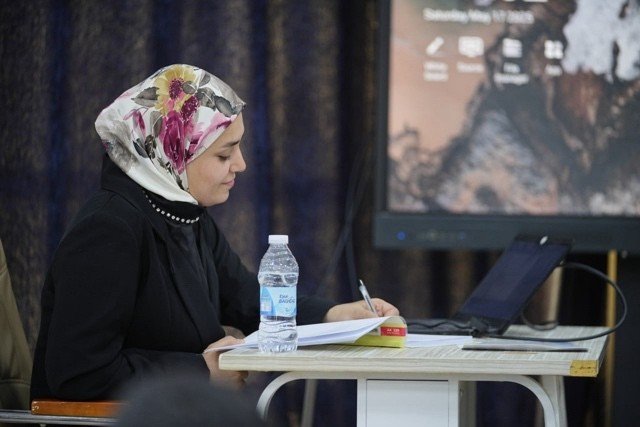
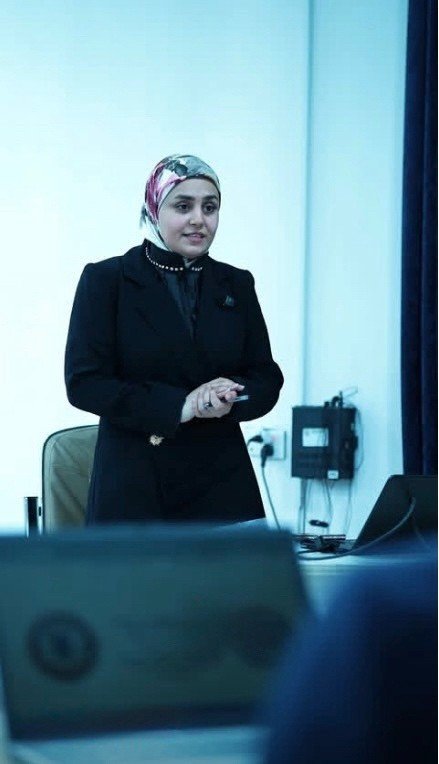
Randa Falah Alassady is a recent graduate of The Islamic University of Najaf, MedTech AI Founder,
She was exhausted, in pain, and moving between different imaging examinations.
During that experience, she found herself thinking beyond her own situation.
What if this were a child?
What if this were an elderly person?
What if someone was already struggling physically and had to go through multiple imaging procedures because the diagnosis was still unclear?
Those questions stayed with her long after she recovered.
As a Medical Imaging Technology student, she already understood the importance of X-rays and CT scans. They save lives every day. But the experience changed the way she thought about healthcare.
Instead of asking how medical imaging works, she began asking how it could work better.
Could technology help doctors reach answers faster?
Could it reduce unnecessary repetition?
Could it help patients avoid additional stress and radiation exposure when better decisions could be made earlier?
Looking back, that was the moment she stopped seeing herself only as a student and started thinking like an innovator.
Growing Up Between Medicine, Engineering and Curiosity
Randa did not grow up with one fixed career in mind.
One day she wanted to become an engineer.
The next day she wanted to become a doctor.
She wanted to be everything.
She describes herself as a child who was deeply curious and unwilling to limit her interests to a single field. Learning itself fascinated her.
Years later, she would realize that this childhood trait became one of her big strengths.
When she entered Medical Imaging Technology, she did not view healthcare through a single lens. She saw medicine, physics, engineering, mathematics, and technology as pieces of the same puzzle.
Rather than choosing one path, she became determined to combine them.
That mindset would eventually become the foundation of AIRanda.
Seeing Healthcare Challenges Up Close
Growing up and training in Al-Najaf, Iraq, exposed Randa to realities that many healthcare innovators only read about in reports.
For patients needing CT scans in public hospitals, waiting times can stretch from two weeks to a full month.
For families who cannot wait, the alternative is private imaging centers.
But a CT scan can cost more than $100, a significant financial burden for many households.
At the same time, standard chest X-rays remain affordable and widely available.
However, that creates another challenge.
Radiologists are often forced to review hundreds of images every day.
Under that level of workload and cognitive fatigue, subtle abnormalities can become easier to miss.
For Randa, this was not merely a technical issue.
It was deeply personal.
She saw patients who could not afford advanced imaging.
She saw doctors struggling under overwhelming workloads.
She saw families facing financial and emotional stress while waiting for answers.
And she began asking a simple but powerful question:
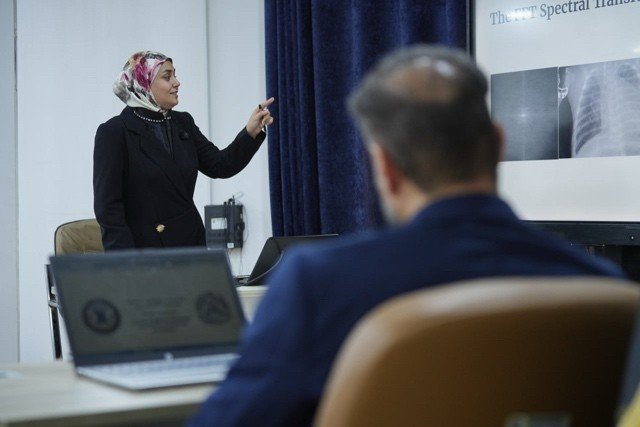
What if artificial intelligence could increase the diagnostic value of a standard chest X-ray enough to reduce unnecessary CT scans?
That question became the foundation of PulmoRai.
Discovering AI and Teaching Herself to Build
Graduation was never the finish line for Randa.
She realized that understanding problems and solving problems are very different things.
The turning point came when she discovered programming and artificial intelligence.
“It felt like uncovering a superpower,” she explains.
Suddenly, she had tools that could transform ideas into real solutions.
While completing her Medical Imaging degree, she began teaching herself programming, software development, machine learning, and artificial intelligence.
There was no computer science degree behind her. No software engineering team. No advanced laboratory.
Her bedroom became her lab.
By day, she attended university classes and clinical training.
By night, she studied Python, read research papers, completed specialized courses, and built experimental models on her laptop.
Most of what she learned came through self-study, persistence, trial and error, and countless hours of experimentation.
Today, she describes herself not as a student with an idea, but as a fully committed innovator focused on scaling her work globally.
Why AIRanda Carries Her Name
The name AIRanda was not chosen casually.
For Randa, it represents ownership, identity, and responsibility.
She combined “AI” with her own name to create AIRanda, a platform that reflects both the technology and the person behind it.
Within the AIRanda ecosystem sits PulmoRai.
“Pulmo” represents the lungs. “Ray” represents X-ray imaging. By coincidence, “Ra” also represents the first letters of her own name.
The result became PulmoRai, connecting personal identity, medical purpose, and technology into one concept.
Building Three Patent-Pending Innovations
Today, AIRanda consists of three British patent-pending innovations designed to address different healthcare challenges.
1. PulmoRai
The first innovation focuses on chest X-ray analysis and clinical decision support. PulmoRai aims to provide AI-powered analysis of chest X-rays to support clinical decision-making, accelerate triage, and reduce pressure on healthcare professionals.
2. Advanced Spectral AI
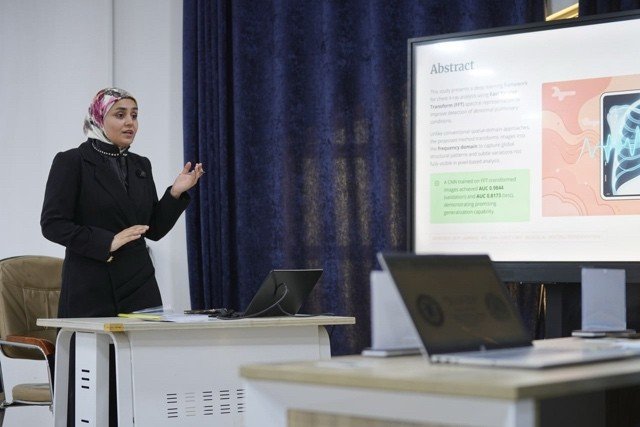
The second innovation emerged from her graduation project. Her spectral intelligence system converts imaging data into audio-frequency spectra and analyzes hidden frequency patterns rather than relying solely on visual information, with the goal of identifying ultra-subtle tissue abnormalities.
3. Smart Hardware for X-Ray Systems
The third innovation is an AI-powered smart assistant for X-ray rooms. It connects to imaging equipment to automate workflows, reduce operational errors, and continuously monitor systems to help prevent equipment breakdowns.
The objective is to improve efficiency, protect expensive imaging equipment, and reduce unnecessary repeat scans without interfering with patients.
Building Deep Technology in Iraq
Building advanced healthcare technology is difficult anywhere. Building it in Iraq presents additional challenges.
Randa faced power interruptions, internet instability, difficulty accessing clean medical datasets, and limited funding opportunities.
Training AI systems often requires uninterrupted computing power. A single power outage can erase hours of work.
Yet she continued, not because it was easy, but because she believed it was necessary.
Facing Skepticism as a Young Woman in Technology
Randa also encountered skepticism. Some questioned whether someone with a healthcare background could successfully learn advanced programming. Others suggested she focus on a traditional radiology career.
Rather than discouraging her, those comments became fuel. She chose to answer with results, research, innovation, patents, and persistence.
The Role of Family and Support
Throughout the journey, her family remained her strongest support system.
They may not have understood every line of code or every technical concept, but they believed in her ability to figure things out.
That belief created the space she needed to experiment, learn, fail, and continue moving forward.
Why Explainable AI Matters
For Randa, explainable AI is not simply a technical feature. It is an ethical responsibility.
She believes healthcare professionals should never be asked to blindly trust a machine. Doctors need to understand why an AI system reaches a conclusion, and patients deserve transparency.
The goal is not to replace clinicians, but to empower them with tools they can understand and trust.
A Vision Beyond Borders
Although AIRanda was inspired by challenges in Iraq, Randa’s vision extends far beyond one country.
Many healthcare systems across the Middle East, Africa, and other emerging regions face similar challenges involving limited resources, diagnostic delays, financial barriers, and workforce pressures.
She believes technology can help bridge those gaps, and she wants AIRanda to become part of that solution.
Her mission is not to leave Iraq behind. It is to prove that world-class innovation can emerge from places where challenges are greatest.
For Randa Falah Alassady, the goal is simple: use artificial intelligence, medical imaging, physics, and engineering to build solutions that improve healthcare for patients everywhere.
What began as a question asked from a hospital bed has become a growing ecosystem of innovations with the potential to impact healthcare far beyond the place where the journey began.
To follow Randa Falah Alassady’s journey in medical imaging, AI, and healthcare innovation, connect with her on LinkedIn: